
The Brain, the Machine, and the Future of Medicine: How Artificial Intelligence and Computational Technologies Are Shaping the Future of Neurosurgery
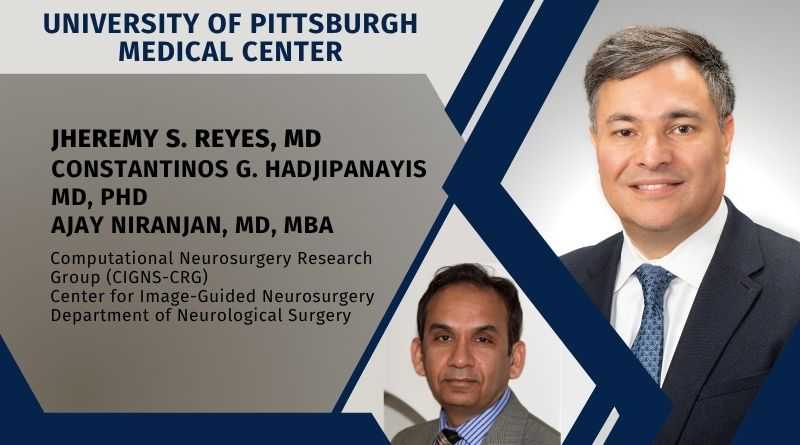
By Jheremy S. Reyes, MD, Constantinos G. Hadjipanayis, MD, PhD, Ajay Niranjan, MD, MBA | Computational Neurosurgery Research Group (CIGNS-CRG), Center for Image-Guided Neurosurgery, Department of Neurological Surgery, University of Pittsburgh Medical Center (UPMC)
A neurosurgeon looking at an MRI scan sees anatomy, disease, function, risk, and possibility. A machine looking at the same image sees pixels, patterns, probabilities, and relationships that may be invisible to the human eye. The future of neurosurgery may depend on how well we learn to bring these two forms of intelligence together.
For decades, neurosurgery has been defined by precision. Every millimeter matters. The difference between preserving function and causing harm may depend on the ability to understand anatomy, interpret imaging, anticipate risk, and make decisions under uncertainty. Modern image-guided neurosurgery already depends on extraordinary technologies: MRI, CT, angiography, tractography, neuronavigation, and microscopy. Advanced detection, visualization, and treatment of central nervous system (CNS) disorders rely on newer technologies such as fluorescence, Raman spectroscopy, robotics, and advanced planning platforms. Yet a new layer is now being added to this technological foundation: artificial intelligence and computational decision-making.
The question is no longer whether AI will enter medicine. It already has. The more important question is whether we can build AI systems that are clinically meaningful, safe, interpretable, and centered on patients rather than technology itself.
The future of neurosurgery will not be brain versus machine. It will be a man with the machine guided by rigorous neurosurgery training and the incorporation of AI.
In neurosurgery, the potential is especially powerful because the field sits at the intersection of anatomy, function, imaging, engineering, physics, and human judgment. Neurosurgeons routinely make decisions based on complex, multimodal information: imaging findings, tumor location, patient age, neurological status, prior treatments, molecular features, expected outcomes, and procedural risks. These decisions are rarely simple. They involve probabilities, tradeoffs, and individualized judgments.
Historically, medical imaging has helped answer one essential question: where is the disease and what functional pathways surround the lesion? Today, artificial intelligence and computational modeling may help answer a more difficult question: what is this disease likely to do next and how will it impact the patient’s life?
This shift from seeing to predicting may define the next era of neurosurgical care. Imaging will remain essential, but its role will expand from anatomical and functional visualization to biological interpretation and outcome prediction. MRI scans, DICOM data, treatment plans, clinical outcomes, and follow-up information will become part of integrated computational systems designed to support patient-specific decisions.
At the Center for Image-Guided Neurosurgery (CIGNS) at UPMC, our work has focused on exploring how intraoperative visualization, therapy, stereotactic radiosurgery, and brain mapping using Magnetoencephalography (MEG) can support more individualized neurosurgical and radiosurgical care. We are interested in investigating how computational tools might assist in converting complex clinical data into useful decision support through interdisciplinary collaboration among neurosurgeons, neuro-oncologists, radiation oncologists, physicists, engineers, data scientists, and clinical researchers. This is also part of the broader vision behind computational neurosurgery: not simply using computers in medicine, but rethinking how we understand disease, treatment, and outcomes through data.
One example is stereotactic radiosurgery (SRS) for CNS disorders. SRS is already one of the most precise forms of treatment in medicine. It allows physicians to deliver focused radiation to intracranial targets while minimizing exposure to surrounding brain structures. However, even within such a precise treatment platform, clinical decisions remain highly individualized. What radiation dose should be used? What is the probability of local tumor control? What is the risk of adverse radiation effects? Which patient may need closer imaging follow-up? Which tumor may behave more aggressively despite similar size or appearance?
Consider a patient with multiple brain metastases. On imaging, several tumors may appear similar: small enhancing targets within the brain. Yet each tumor may have a different volume, location, relationship to surrounding structures, biological behavior, and probability of response. A future AI-assisted system should not simply recommend that all tumors be treated the same way. Instead, it could help estimate individualized probabilities of tumor control, toxicity, progression, and need for additional management. This information would not replace the physician. Rather, it would provide a more precise map of uncertainty.
Automation for the sake of automation is not the goal. The goal is augmentation. The question is not whether artificial intelligence can outperform physicians. The more pertinent question is whether it can help doctors forecast outcomes and improve patient care.
Despite its promise, adopting AI in neurosurgery is not easy. The greatest barrier is often not the algorithm itself, but the reality of clinical data. Medical datasets are frequently incomplete, heterogeneous, and difficult to standardize. Imaging protocols vary across institutions. Follow-up intervals are inconsistent. Outcomes may be defined differently between clinicians, studies, and centers. Treatment decisions are influenced by patient factors, physician judgment, institutional practice, and evolving technologies. These realities make medical AI far more complex than simply training a model and reporting an accuracy score.
In healthcare, an algorithm is not valuable simply because it performs well in a dataset. It becomes valuable only when it is reproducible, interpretable, externally validated, ethically developed, and clinically useful. A powerful model trained on weak data can produce confident answers to the wrong questions. This is why responsible AI development requires transparency, multidisciplinary oversight, and a deep understanding of clinical context.
The positive impact of emerging computational technologies could be enormous. AI may help improve risk stratification, personalize treatment planning, reduce unnecessary variability, support earlier detection of complications, optimize follow-up, accelerate research, and identify patterns across large datasets that no single clinician could analyze alone. For patients, this could mean more personalized care. For clinicians, it could mean better tools for decision-making. For health systems, it could mean more efficient and evidence-informed workflows.
But the risks are equally important. AI can amplify bias if trained on nonrepresentative data. It can create false confidence if results are presented without uncertainty. It can widen disparities if only large institutions have access to advanced tools. It can also weaken clinical reasoning if physicians become overly dependent on algorithmic outputs. The future of AI in neurosurgery must therefore be built around responsibility, not hype.
The machine may calculate probabilities, but the physician must still carry the responsibility of care.
The next generation of neurosurgery will likely be shaped by the integration of medical imaging, machine learning, radiomics, predictive modeling, robotics, augmented reality, cloud computing, and secure multicenter data-sharing. In this future, treatment may increasingly move away from population averages and toward individualized models of anatomy, disease behavior, risk, and response.
This does not make neurosurgery less human. In fact, it may make the human role even more important. As technology becomes more powerful, clinicians will need to become better interpreters, supervisors, and ethical stewards of computational tools.
The future of neurosurgery will not be brain versus machine. It will be a man with the machine guided by rigorous neurosurgery training and the incorporation of AI. The brain will always require human judgment. But the future of medicine may belong to those who can combine that judgment with intelligent technologies designed around the patient.