
Measuring Only Half The Equation: The Unquantified Benefit in Diagnostic Imaging
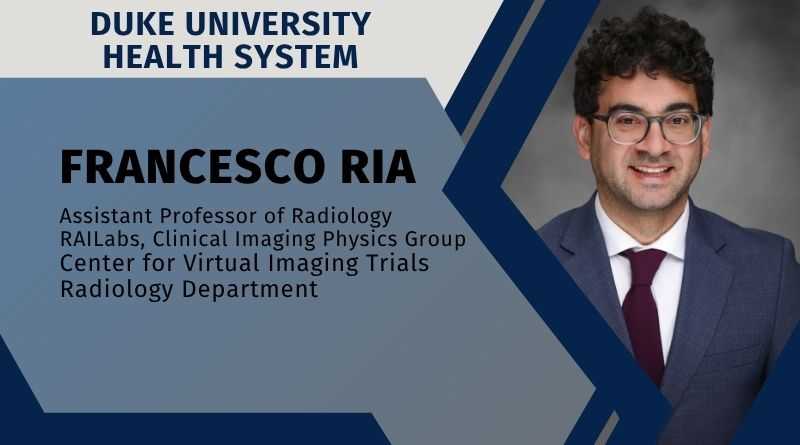
By Francesco Ria, Assistant Professor of Radiology, RAILabs, Clinical Imaging Physics Group, Center for Virtual Imaging Trials, Radiology Department, Duke University Health System
Over the last fifteen years, radiation dose from CT examinations has decreased by nearly an order of magnitude. Yet we lack equally robust evidence demonstrating that this reduction has improved patient outcomes. Could further dose reduction, in some cases, increase overall patient risk?
This apparent paradox invites a closer examination of the principle that has guided radiological protection for decades: ALARA. What does ALARA exactly mean? As Low As Reasonably Achievable. Almost nobody remembers the second part of the principle: taking into account economic and societal factors. I would add that it also should be taken into account that medical factors. Let us proceed in order, following international recommendations and guidelines as a navigation system.
Like every medical procedure, diagnostic imaging exams have to be justified and optimized. In general, a medical exposure is justified if it does more good than harm to the patient. By embracing this consideration, the use of radiation in medicine is accepted. However, in the medical context, the International Commission of Radiological Protection (ICRP) identifies two extra levels of justification (1). In particular, the second justification layer focuses on the procedure itself, asking the question: Does this radiological procedure actually improve diagnosis and treatment? For example, is the use of CT appropriate for patients with specific clinical indications? Lastly, the third level of justification focuses on judging if a particular procedure will do more good than harm to the individual patient.
The ultimate goal of medicine is to maximize patient value. Radiology can do so by providing unique diagnostic information that is essential in guiding clinical decision-making.
After it is justified, like in every other medical field, an imaging procedure needs to be optimized. Meaning that it should be improved in order to minimize the risks for the patients while maximizing the clinical benefits. The ICRP clearly calls for the implementation of diagnostic reference levels as a tool to achieve optimization of radiological procedures. In practice, locally or nationally, radiation dose levels are defined to indicate if routine exams result in exposure higher or lower compared to the associated reference level.
This approach has been implemented for decades, leading to extraordinary results. Over the last 15 years, for instance, the radiation exposure associated with CT decreased by nearly tenfold (2). However, uniquely in the medical field, such a quantitative assessment of risk reduction in radiology has not been complemented by a similar quantitative analysis of the associated benefits. The diagnostic effectiveness, in fact, is related to the quality of the radiological images, which can be deteriorated by the use of lower doses. Therefore, merely pursuing patient exposure reduction can be detrimental to the patient’s benefits.
The ICRP warned of this potential risk: In principle, it might be possible to choose a lower diagnostic reference level below which the doses would be too low to provide a sufficiently good image quality. However, such diagnostic reference levels are difficult to set because factors other than dose also influence image quality. Nevertheless, if the observed doses or administered activities are consistently far below the diagnostic reference level, there should be a local review of the quality of the images obtained (1). However, this call remained unanswered to this day, and no national or local reference levels for image quality have been implemented.
This disconnect establishes a singularity in medicine where radiology is the only specialty in which the risks are selectively amplified. Moreover, diagnostic imaging risks are often assessed quantitatively. Whereas the benefits, namely the quality of the diagnostic image, are assessed qualitatively, based on practitioners’ perception and preference. If we consider the two principles of justification and optimization, the first is the comparison of the risks and the benefits. The goal of the second is the minimization of the risks and the maximization of the benefits. How can we compare these tasks if one quantity, the risks, is measured with numbers, and the second quantity is simply a subjective qualitative assessment?
Such an anomaly biased the entire practice of radiology, in which more energy and resources are invested in radiation dose reduction, compared to those invested in quality improvement. A study from 2021 counted a total of 12 metrics to characterize radiation risk in CT (3). In comparison, there are no metrics and methods assessing the potential benefit of a radiological procedure. To overcome this impasse, in 2018, a panel from the IAEA proposed to estimate the likelihood of a misdiagnosis, as the reciprocal of the benefit (4). This new quantity can be called clinical risk and its quantification with the same units enables the comparison with the radiation risk. Such a novel approach was never demonstrated and implemented in clinical scenarios until last year, when a group from Duke University proposed a definition of a framework to estimate a total risk index in CT, including the associated radiation risk and clinical benefit (5).
To define the total risk index, Duke researchers considered the radiation burden to the patient, disease prevalence, false positive rate, expected life-expectancy loss for an incorrect diagnosis, and the radiologist’s interpretative performance (i.e., area under the receiver operating characteristic curve). Furthermore, patient sex, age, and race were also included in the mathematical model as these factors affect risk and benefit evaluation. To prove the concept, the new model was applied to a population of one million digital twins simulating a real clinical cancer scenario of detecting liver cancer. For the simulated population, researchers found that clinical risk outweighed radiation risk by at least 400% (5).
The research then focused on determining what exposure parameters can minimize the total risk. For each digital twin, the study calculated both radiation and clinical risk, considering 2000 different radiation dose exposures. The results showed that in 90% of cases, an increase in radiation dose, compared with standard clinical practice, would reduce overall patient risk. Such counterintuitive evidence highlighted that exaggerated dose reductions can be detrimental to the quality of radiological images and even harm patients.
The ultimate goal of medicine is to maximize patient value. Radiology can do so by providing unique diagnostic information that is essential in guiding clinical decision-making. A mature application of ALARA, therefore, requires a conceptual evolution. “As Low As Reasonably Achievable” cannot be interpreted as “as low as technologically possible,” nor pursued as an isolated effort to reduce exposure independent of clinical performance. The responsibility of radiology professionals is not merely to reduce exposure, but to determine, through quantitative and patient-centered assessment, the right dose that minimizes total harm while preserving diagnostic integrity.
1. Icrp. The 2007 Recommendations of the International Commission on Radiological Protection. ICRP Publication 103. Annals of the ICRP. 2007;37(2-4):9-34.
2. McCollough CH, Yu L. CT Radiation Dose Reduction With Preserved Diagnostic Performance: How Far Have We Come Over 25 Years? American Journal of Roentgenology. 2026.
3. Ria F, Fu W, Hoye J, Segars WP, Kapadia AJ, Samei E. Comparison of 12 surrogates to characterize CT radiation risk across a clinical population. European Radiology. 2021;31(9):7022-30.
4. Samei E, Järvinen H, Kortesniemi M, Simantirakis G, Goh C, Wallace A, et al. Medical imaging dose optimisation from the ground up: Expert opinion of an international summit. Journal of Radiological Protection. 2018;38(3):967-89.
5. Ria F, Zhang AR, Lerebours R, Erkanli A, Abadi E, Marin D, et al. Optimization of abdominal CT based on a model of total risk minimization by putting radiation risk in perspective with imaging benefit. Communications Medicine. 2024;4(1):272.